
Call for Family Matters
· DBF Team
Something that having two Active Pokémon opens the door to that should always be considered, is Support Pokémon. Now, there are several options for mid-game consistency Pokémon, such as Scrafty — but something that we’ll talk about today is the lost art of the Call for Family user.
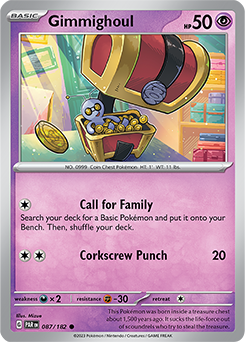
Now, for a bit of context, you might recall the Attack name “Call for Family” on your 50 HP Gimmighoul or 50 HP Pidgey from your Gholdengo-EX or Charizard-EX decks, respectively. These attacks are useful in a pinch, and they “refund” a bad start in some cases by allowing you to set up your board whenever you need it.
Usually, the big drawback of a Call for Family attack is the opportunity cost of it not being something else that’s more useful in an immediate sense (like Budew), or the clunkiness of getting it active early enough to be useful thanks to its Energy cost.
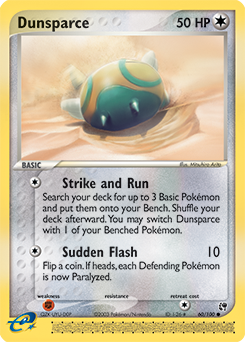
Some cards have gotten around this by being simply better than other options, such as the rather famous example of Dunsparce from Sandstorm (circa 2003)’s Strike and Run attack which even allowed you to switch Dunsparce for a defensive Pokémon that you just benched, while having a useful second attack and grabbing you a monstrous 3 Pokémon. Alolan Vulpix from Guardians Rising is another good example of a Call for Family-mon who saw decent play, that even allowed you to search for evolution Pokémon without the Energy investment.
Double Battle Format has a very unique ability to not only allow you to play such Pokémon effectively, but also without the opportunity cost that you might expect from normal Call for Family attacks. There are a few aspects to this that make it viable, and there’s a very specific Pokémon that I’d like to talk about as a mainstay of this effect as well.
So, why should you care?
There are several aspects of DBF that not only support such strategies, but also throughlines in the format that almost necessitates them in some cases — especially after Rotation. Let’s go over the various benefits to Call for Family attacks in your deck.
Firstly, Call for Family-mons (or CFF-mons for short), can fill in the “holes” in your deck’s consistency backbone. With only two copies of cards max in your decks, you’ll find that your consistency cards and search cards are a bit lacking in some ways. Having an attack that can search out your Pokémon, especially when you pair it with an early-game aggressor or stall card like Ethan’s Pichu or Budew, can set up your board without losing the opportunity cost you’d have in Standard.
Aside from making your deck more consistent, DBF also allows you to easily promote them to the Active Spot during the first turns of the game. This is due to the promotion rules for DBF — if you start with only one Pokémon, you automatically promote whatever Pokémon you bench next. Ergo, if you play a search card or bench them from your hand, you can automatically promote your chosen Call for Family user into your other Active Spot.
This means that not only can you use a Call for Family-esque attack consistently, you are practically incentivized to do so. Even moreso when you consider you can play turn-one attacking Pokémon to make your first turn even stronger — like the ones below.
Volbeat ‘em Up
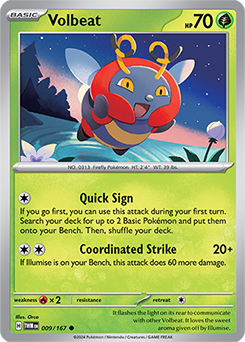
This little firefly is basically the most consistent thing in the world.
Volbeat allows you to promote it on the first turn of the game, then search out two Basic Pokémon using its attack — an attack that only takes one Colorless Energy, which means you can put it in anything.
Not only does this allow you to bench Pokémon quickly so that you can evolve them on your second turn, it also allows you to find “thicker” Pokémon like Hisuian Growlithe, Turtwig, or other 80+ HP Pokémon that you can’t find with cards like Buddy-Buddy Poffin.
If you really want to be greedy, you can use Illumise to make Volbeat a threatening attacker mid-game, but let’s pace ourselves on that one. With only four benched spots, and Illumise required to be there, you’ll be limiting your options quite a bit. Sure, it’s the same situation as Lunatone and Solrock, but Solrock fights for a single Energy, and Lunatone draws cards from the bench — Ilumise just sits there and looks neat.
Besides, ideally they knock out Volbeat eventually anyway. His second attack isn’t as useful as Dunsparce, but his first attack almost certainly is.
Where’s Bullwinkle?
Volbeat serves a purpose as a turn 1 play that doesn’t really punish you over time, giving you an edge in the early game. If you go first, Volbeat can certainly grant you an explosive board presence with a low-risk and high-consistency play using its turn 1 attack capabilities.
But, what if you go second?
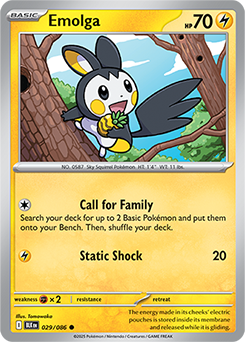
That’s where Emolga comes in. Not only does it still take colorless Energy to use a Call for Family attack, it also has free retreat, something that Volbeat wishes it has. This is important for a few reasons.
The first is, as a “starter” Pokémon that you set up with, Emolga having free retreat allows it to easily move out of the Active Spot in the first turn in order to retreat for a Budew or other attacker, like a Solrock or a Fan Rotom. After all, sometimes you don’t need a Call for Family-user — you might just start with a ton of search in your hand and not end up needing to attack with it, meaning it would be more efficient for you to attack with something else.
Another reason is, with limited benched spots, a Call for Family-mon is just a bit dangerous to have in play. Like we mentioned with Volbeat, the ideal situation is that your opponent knocks out Volbeat during their turn, while you use it to set up. But, a clever opponent won’t do that — they’ll use cards like Repel to push it out of the Active spot to claim your benched Pokémon, and force you to keep a Call for Family-mon in play. This takes up a valuable bench spot, and you ironically end up being limited by the thing that helped you set up.
Conversely, Boss’s Orders allows opponents to stall your Call for Family-mon in the Active spot, forcing you to devote resources to get it out of the Active in favor of your optimal attacker. With Emolga’s free retreat, not only does it mean that you won’t get “Boss Stalled” &mdash it means you’ll get to use Emolga as a pivot later once your Active Pokémon get knocked out mid and late game.
In Closing
Consistency is key. This is a common throughline in many different games, not just Pokémon, but with the expanded capabilities and more narrow options for search after rotation, the Call for Family-mon is a lost art that is rapidly returning to the mainline.
It would be my suggestion that you play both of the above options in your decks, just by virtue of covering your weaknesses. Of course, that doesn’t mean you’ll play both at the same time in a game (unless you’re bonkers), but it does mean that you’ll be able to play either when they’re at their most optimal.
Which are your favorites? What will you be bringing to the table? One of the above options, both, or neither? Join the community and show us what you’re cooking up! I’m excited to see what you’ll come up with!